How To Write CfP Submissions That Get Your Tech Conference Talk Accepted
You've got a great idea for a tech talk, but your submissions keep getting rejected. The problem is (in most cases) not your topic—it's how you're representing it in your abstract. After reviewing thousands of talk abstracts during Calls for Papers (CfPs) as a program committee member and getting 60+ of my own talks accepted at conferences worldwide, I've seen the same patterns over and over again. In this post, I’ll share with you how to write a great abstract with writing tips and examples.
TL;DR: Most abstracts fail because speakers treat them like rough sketches instead of compelling arguments. Your abstract needs to prove three things: you understand your audience, you know exactly what you'll cover, and you're the right person to present this topic. Don't optimize for intrigue—optimize for demonstrating competence.
The Reality Check: What You're Actually Asking For With Your Abstract
Consider this: By submitting a proposal for a conference, you're asking a handful of people who may never have heard of you who are tasked with programming a successful event that people pay for, and you’re asking them to give you access to 10-45 minutes of 50 to 5,000 people's time and attention. That's a lot of minutes. As presentation research manager Ken Haemer noted,
"Designing a presentation without an audience in mind is like writing a love letter and addressing it 'to whom it may concern.'"
(Quoted from the excellent “Resonate” by Nancy Duarte.) Your abstract is your chance to prove you've thought beyond your own interests.
The Three Fatal Flaws That Kill Abstracts
Most abstracts I review fail for the same reasons:
Flaw #1: Generic Topic + No Audience Connection
The abstract reads like it was copy-pasted to sixty different conferences. There's no evidence the speaker considered who will be in the seats or what those people need. I see proposals about "microservices best practices" that could apply equally to a startup meetup or an enterprise architecture conference—which probably means it's not tailored for either.
Flaw #2: Missing the "Why You?" Factor
The proposal tells me what the topic is but not why this particular person should present it. Anyone could have written it. There's no indication of specific experience, unique perspective or interesting insight that makes this speaker the right choice to talk about this topic.
Flaw #3: Vague Value Proposition
The abstract promises the audience will "learn best practices" or "gain insights" but doesn't specify what they'll actually be able to do differently after attending, how they'll feel differently, or what else will change for them. Reviewers need to understand the concrete takeaway that will make it worth the audience's time.
How To Craft Very Good Abstracts
Essential Questions Your Abstract Must Answer
Every successful abstract clearly addresses these questions:
Why does the topic matter to this audience?
What key ideas are you going to cover?
Why do you want to talk about this?
What will the audience take away from it?
Let’s dig into each of these, and look at a successful abstract below that outlines what this can look like in practice.
1. Why does this topic matter to this audience?
Who is your audience? Picture them as individuals: What are their jobs/roles, their skills, vulnerabilities? What's on their minds and what do they care about? How do they currently feel/think about your topic? What are they good at, and what do they struggle with?
2. What are you going to cover? Develop Your Compelling Idea and Angle
This is where you demonstrate that you have thought through the essential elements of your talk. Outline the concrete questions/aspects of the subject that you'll address—typically 1 for a 10-minute talk, 2-4 for a talk up to 30 minutes.
Standing out starts with choosing the right angle, especially for common topics:
For Evergreen Topics (feedback, 1:1s, team building, being new to a role): Get specific to escape clichés. Instead of "how to give feedback," what's your unique approach? Maybe you've discovered that feedback timing matters more than delivery style, based on data from 200+ performance reviews you've conducted. Or you've developed a framework that works specifically for remote distributed teams. Consider the extremes: What's the weirdest 1:1 you've had? The most boring one? What did you learn from those that could be applicable more broadly? Or consider patterns: What do you keep on seeing happening?
For Hot Topics (AI, productivity, efficiency): Research what others have covered and find your differentiated perspective. Are you approaching AI adoption from a technical debt angle? Have you seen productivity initiatives backfire in specific ways? What's the story only you can tell?
For Niche Topics: Make the relevance crystal clear. If you're speaking about weather patterns at a software development conference, the connection better be obvious and valuable—perhaps you're discussing how meteorological modeling techniques improved your system architecture.
Here's a practical exercise: Write down why you're passionate about this topic, then identify the most specific, concrete example from your experience. That specificity is often where your unique angle lives.
Pro tip: Try comedy writing techniques. A few years ago, I took a stand-up comedy workshop to work on some of my talk writing and stage craft. If you want to find more creative ways to present topics or develop new angles, I highly recommend comedy writing material, like these topic development exercises that include prompts and free association exercises.
3. Why do You want to talk about it? Demonstrate Your Credibility
Especially with topics that are likely to be submitted by various people, you need to demonstrate why you specifically should be the person to talk about this. What makes you uniquely qualified? What perspective, experience, motivation do you specifically bring to it? Avoid the resume dump. Instead of listing credentials, weave your qualifications into the narrative through specific examples or numbers that highlight key aspects of your experience.
Weak: "As an experienced engineering manager with a background in scaling teams..."
Strong: "Having guided three different teams through 3x growth over two years—including one team that went from 3 to 30 engineers in eight months—I've learned that the conventional wisdom about team scaling often breaks down at specific inflection points."
Weak: "I've worked extensively with microservices..."
Strong: "After migrating four monoliths to microservices across different companies and seeing two migrations fail spectacularly, I've identified the critical decisions that determine success or failure in the first 90 days."
The specifics do two things: they prove you have real experience, and they hint at the unique insights you'll share.
4. What will the audience take away from your talk?
Write them out as questions you'll answer or as directional ideas—e.g., "walk away with a framework they can apply in their day-to-day", "increase their understanding of xyz." It doesn't always have to be super specific yet, but it needs to be very clear that you have considered that.
Anatomy of a Successful Abstract
Let me walk you through my accepted abstract for my talk "Stop! Strategy Time!" (video; in written form, part 1 and part 2) to show these principles in action:
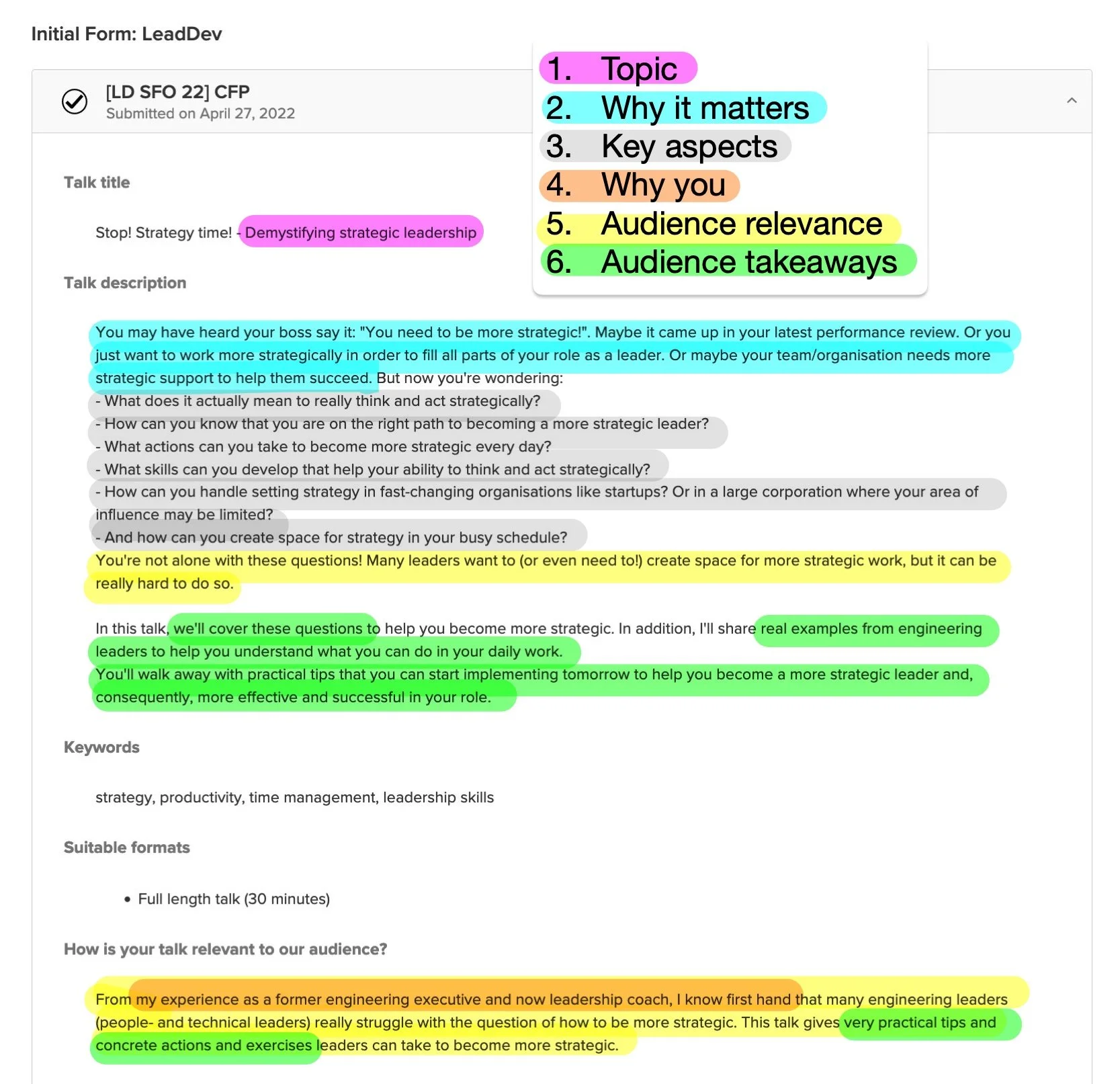
vTalk title: Stop! Strategy Time! (...or are we really stopping?)
Why the topic matters: You may have heard your boss say it: "You need to be more strategic!". Maybe it came up in your latest performance review. Or you just want to work more strategically in order to fill all parts of your role as a leader. Or maybe your team/organisation needs more strategic support to help them succeed. But now you're wondering:
Key content pillars (specific questions I'll address):
What does it actually mean to really think and act strategically?
How can you know that you are on the right path to becoming a more strategic leader?
What actions can you take to become more strategic every day?
What skills can you develop that help your ability to think and act strategically?
How can you handle setting strategy in fast-changing organisations like startups? Or in a large corporation where your area of influence may be limited?
And how can you create space for strategy in your busy schedule?
Note: Those were a few too many questions for the 25-minute talk I proposed here. If I were to propose this talk again, I’d narrow it down to 2-3.
Audience connection: You're not alone with these questions! Many leaders want to (or even need to!) create space for more strategic work, but it can be really hard to do so.
Concrete takeaways: In this talk, we'll cover these questions to help you become more strategic. In addition, I'll share real examples from engineering leaders to help you understand what you can do in your daily work.
You'll walk away with practical tips that you can start implementing tomorrow to help you become a more strategic leader and, consequently, more effective and successful in your role.
Why me: From my experience as a former engineering executive and now leadership coach, I know first hand that many engineering leaders (people- and technical leaders) really struggle with the question of how to be more strategic. This talk gives very practical tips and concrete actions and exercises leaders can take to become more strategic.
Your Abstract Review Checklist
Before submitting, ask yourself (or have others review) these questions that should all be covered in your abstract:
Why does the topic matter to this audience?
What key ideas are you going to cover? Outline the key aspects you will explore, e.g. guiding questions, angles?
Why do you want to talk about this? What perspective, experience, motivation do you specifically bring to it?
What will the audience take away from it?
Remember: The main purpose of the proposal is to convey to the conference programming committee that you know your topic, what you're talking about, and that you'd a good person to do so. Don't optimize for intrigue—it's not a marketing device! If you are concerned about giving away too much and want to add intrigue for your future audience, once your proposal has been accepted, you can always ask conference organizers to release a modified version in the programme.
And now, maybe most importantly: Submit your talk! You’ve got something to say, so craft a good abstract that conveys your ability to say it.
Good luck!